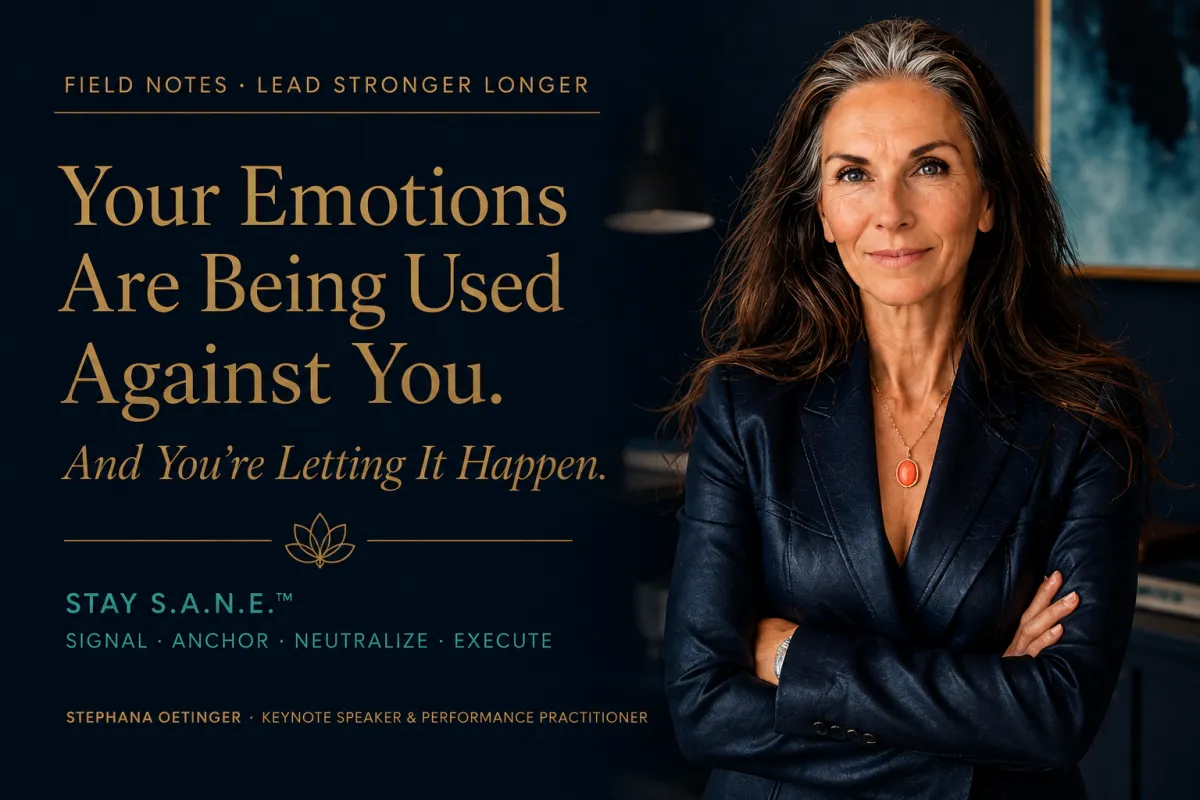
Your Emotions Are Being Used Against You — And You're Letting It Happen
The Moment You Think You're Feeling Something, You're Already Being Managed
You walk into a high-stakes meeting and someone says something that lands wrong. Your chest tightens. Your jaw sets. A familiar urgency rises... say something, defend yourself, prove your point.
And just like that, you're no longer leading. You're reacting.
What no one tells high-performing women: that reaction didn't happen by accident. It was invited. And in many cases, whether in boardrooms, in relationships, in negotiations, in public discourse, your emotional response was the whole point. Because a person who is emotionally hijacked is infinitely easier to manage than one who isn't.
Your emotions are not your enemy. But they can absolutely be used as a weapon — against you — if you don't know how to read them first.
Here's what "Emotional Strategy" actually means...
When Emotion Becomes a Tool for Control
Emotional strategy is not a conspiracy theory. It is a documented, studied, and widely practiced method of influence. Politicians use it. Media uses it. Abusive partners use it. Manipulative colleagues use it. Even well-meaning people use it without realizing they are.
The mechanism is simple: trigger an emotion strong enough to override rational thinking, and the person in that emotional state becomes reactive rather than responsive. They make decisions from urgency, fear, shame, or outrage - not from clarity.
The higher you rise as a leader, the more frequently this happens and the higher the stakes when it does.
What separates leaders who sustain their performance from those who burn out or derail is not intelligence, credentials, or even strategy. It is the capacity to read their own internal state before it reads them.
The Stay S.A.N.E. Method: A Framework for Leaders Who Refuse to Be Managed
S — Signal
The body always tells the truth before the mind catches up.
Every emotional hijack begins with a signal. Tension in the shoulders. A flash of heat in the chest. The sudden urgency to respond immediately. Fatigue that appears out of nowhere when you're facing a difficult conversation.
These are not problems. They are data.
Pain and discomfort are signals - leadership data, not identity. The moment you pathologize your internal response ("I'm too sensitive," "I overreact," "I can't handle this"), you lose access to the most accurate information your nervous system is trying to give you.
The first skill of a high-performing leader is learning to name the signal before acting on it.
What is your body telling you right now?
A — Anchor
Leaders without anchors become reactors — and reactors cannot lead movements.
Anchoring is not the same as bypassing. It is not suppression. It is not pretending the signal isn't there.
Anchoring means grounding yourself before you respond. It's connecting to something steady while the emotional weather passes through. It might be a breath. A physical sensation. A values statement you've internalized. Stillness. Silence.
An anchor is whatever brings you back to yourself when the environment is trying to pull you into its agenda.
Without an anchor, your response time collapses and your reactivity increases. With one, you buy yourself the seconds (or minutes) that separate a great leader from a good one.
N — Neutralize
Suppression buries the charge. Neutralizing metabolizes it. These are not the same thing.
This is the distinction that most leadership development programs miss entirely.
Suppression says: don't feel this. Push it down. Show up professional. Perform composure.
Neutralization says: feel this fully, move the energy through, and release the charge so it no longer drives your behavior.
The signal is always there. The problem is that most high performers have been trained to call that signal "anxiety" or "weakness" and suppress it — which means the charge doesn't disappear. It accumulates. It shows up later as a misplaced outburst, a decision made from exhaustion, or a health crisis that announces what the nervous system has been carrying for years.
Neutralizing is the skill. It is learnable. And it is non-negotiable for leaders who intend to sustain their performance over time.
E — Execute
Leadership actually happens after the storm — not in it.
Execute means you take action, but from a place of clarity rather than reaction. From choice rather than compulsion. From your values and your strategy rather than from someone else's emotional agenda.
This is where most frameworks stop. They tell you to "stay calm" or "respond don't react" without giving you the actual physiology and practice to do so under real pressure.
The Stay S.A.N.E. Method exists because staying calm is not a decision you make in the moment. It is a capacity you build before the moment arrives.
The Two Powerhouses Every Leader Must Know
The Inner Architecture That Either Holds You... or Doesn't
There are two powerhouses that determine how you show up when the pressure is real.
The Physical Powerhouse is your body and nervous system — the hardware. It is the seat of your signal detection. When it is regulated, rested, and trained, you can read your environment accurately and respond from strength. When it is depleted, overridden, and chronically stressed, it becomes the source of reactivity rather than the resource for recovery.
The Mental Powerhouse is your subconscious — the software. It drives 95% of your behavior. The beliefs you formed about emotion, conflict, power, and safety before you ever had language for them are running your leadership right now. The programming that tells you your feelings are a liability rather than an asset? That is subconscious architecture. It can be changed. But not by thinking your way out of it.
The world does not need more information. It needs more leaders who can hold their center while everything burns around them. That is not a gift some people are born with. It is a skill that is developed through specific, intentional practice.
What This Means for You
The Question No One Is Asking in Your Leadership Training
If your feelings can be triggered on demand, your decisions can be influenced on demand. That is not a small thing.
The leaders who sustain peak performance — who maintain clarity in crisis, who build cultures others want to stay in, who make decisions that hold up over time — are not the ones who feel less. They are the ones who have built the internal architecture to work with what they feel rather than being driven by it or suppressed by it.
S.A.N.E. is not a stress management technique. It is a leadership survival skill.
And it starts with a question you may not have been asked before: What signal is your body sending you right now — and have you been trained to ignore it?
Ready to Build That Architecture?
The 5-Day Powerhouse Activation is your starting point, a free entry into the Stay S.A.N.E. methodology and the Yogilachi® performance framework that underpins it.
Go to POWERHOUSE to get started.
Stephana Oetinger is a keynote speaker, performance practitioner, and four-time author with 36 years of experience and 27,000+ clients. She is the founder of Lead Stronger Longer® and Yogilachi® and the creator of the Stay S.A.N.E.™ Method.